
HMRC agent registration: what the 13 July regulations actually confirmed



In short: regulations made on 13 July 2026 (SI 2026/807) confirm mandatory tax adviser registration with HMRC from 18 August 2026. Firms holding an agent services account before that date are automatically treated as registered - but must name their relevant individuals and evidence AML supervision when HMRC contacts them, expected early 2027. Firms without an ASA register in one of four tranches, the first closing 17 August 2026.
If your firm files anything with HMRC on a client's behalf, the rules governing your right to do it just became law. The Finance Act 2026 requires every business interacting with HMRC about someone else's tax affairs to register as a tax adviser, and the regulations made on 13 July set the timetable in stone.
The headline date is 18 August. The useful news is what sits underneath it, because for most established firms the answer to "what do I do on 18 August?" is: nothing. And for a smaller group, the real deadline is actually the day before.
Do firms with an agent services account need to do anything by 18 August?
No. If your firm holds an agent services account (ASA) immediately before 18 August 2026, the regulations treat you as if you had applied, been approved, and been registered with effect from that date. No form, no fee, no action on the day.
But deemed registered is not the same as done. Firms in this group will still need to complete a process when HMRC makes contact - expected early 2027 - naming the firm's relevant individuals and providing evidence of anti-money laundering supervision.
That's the part to diary now, while it's fresh. The August date will pass quietly for ASA holders, the story will drop out of the trade press, and the actual work will arrive months later as a letter someone has to action. The firms caught out by this rule won't be caught in August. They'll be caught in the new year, hunting for who counts as a "relevant individual" and where the supervision evidence lives.
What counts as evidence of AML supervision?
Less than you'd fear. HMRC has confirmed it will accept a screenshot of your firm's entry on ICAEW's "find a chartered accountant" directory as confirmation that ICAEW supervises the firm.
A screenshot. After a year of prescriptive evidence standards elsewhere, it's almost disorientingly simple - which means the sensible move is to take it now, date it, and file it where whoever opens HMRC's letter in 2027 will find it. Thirty seconds of work today saves a scramble in six months, and it's the rare compliance job you can finish before your coffee goes cold.
What if your firm doesn't have an ASA?
Then the timetable has teeth, and the first one bites in a month. Advisers without an ASA before 18 August fall into one of four tranches, each with a three-month registration window:
| Tranche | Window opens | Window closes | Who it covers |
|---|---|---|---|
| First | 18 May 2026 | 17 August 2026 | Advisers not in any other tranche |
| Second | 18 Aug 2026 | 17 Nov 2026 | Advisers with a self assessment or corporation tax online services account (not in tranches 3–4) |
| Third | 18 Nov 2026 | 17 Feb 2027 | Advisers whose only adviser activity in the period is payroll services |
| Fourth | 31 Dec 2026 | 31 Mar 2027 | Advisers whose business substantially consists of regulated activities, or whose clients are substantially group undertakings of such a business |
Notice the first tranche: it closes on 17 August, the day before the date everyone has written down. If your firm has no ASA and no online services account for self assessment or corporation tax, your window is already open and shuts in a month. HMRC has published an interactive tool to confirm which tranche a business falls into - worth running rather than assuming.
One reassurance the regulations spell out: businesses can continue interacting with HMRC throughout their registration window and while an application is being considered. Nobody gets locked out mid-process for being in the queue.
The bigger pattern: the firm is now the client
Step back from the tranches and something larger comes into focus. This is the third registration-and-evidence regime to land on practices in about twelve months. Companies House now requires ACSP registration and seven-year identity verification records. MTD for Income Tax puts quarterly obligations on the client book, with the first update due 7 August - eleven days before this regime begins. And now HMRC wants every tax adviser registered, with named individuals and supervision evidence on file.
You have spent a career collecting evidence from clients. From this August, the regulators start collecting it from you.
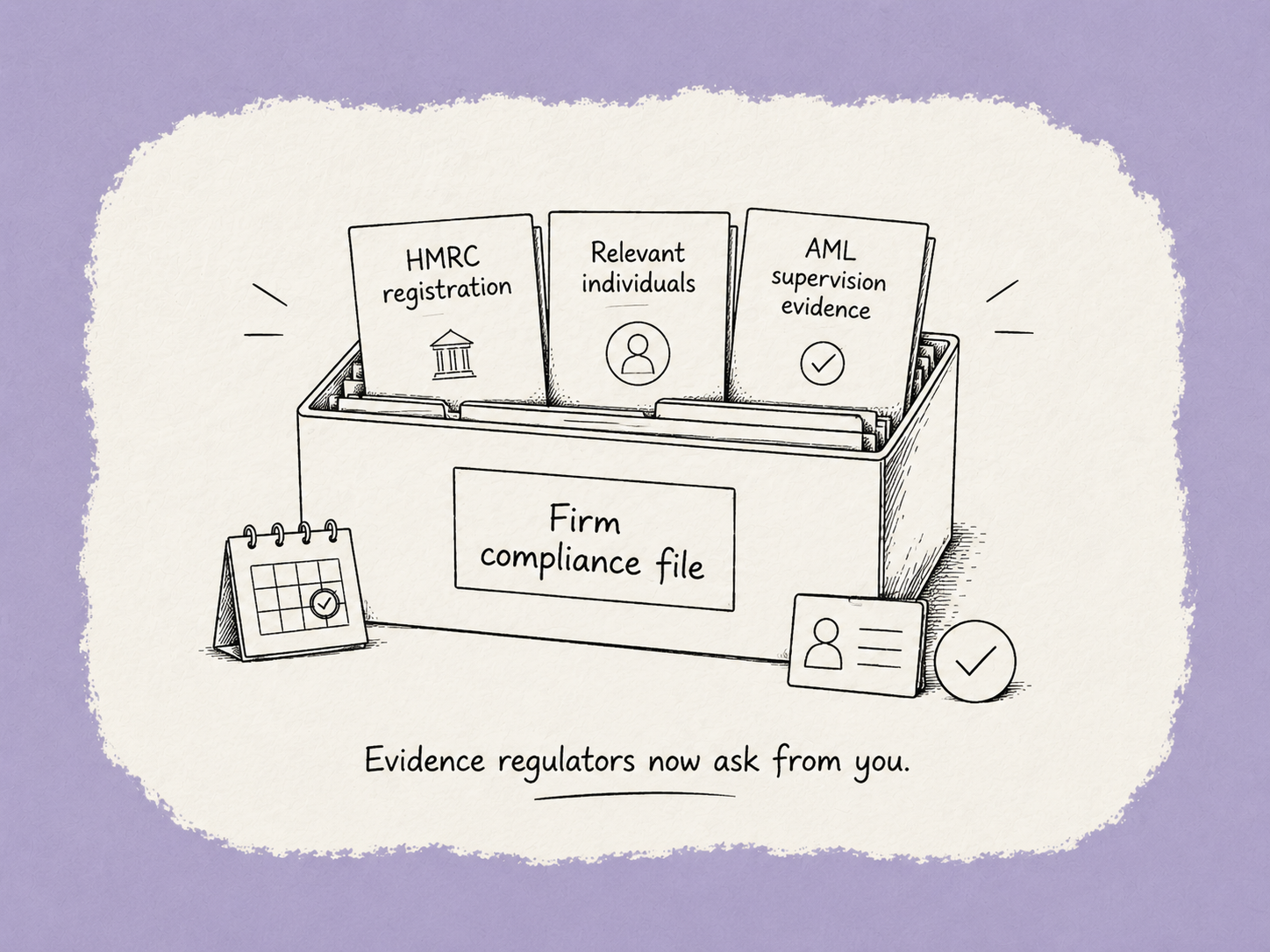
Which means the firm's own compliance file - the supervision evidence, the record of who your relevant individuals are, the registrations and their dates - is quietly becoming an asset that needs the same discipline as a client file: kept somewhere findable, independent of whoever set it up, ready to produce years after the person who filed it has moved on. That's the same test the ACSP seven-year rule sets, and the same one your working papers already pass for clients. The only change is who the record is about.
For the client-facing half of August's double, our piece on the MTD maths and what it does to headcount covers the 7 August side. For how firms keep evidence filed against the record it belongs to, see how practices handle AML and onboarding evidence in one flow.
FAQs
When does mandatory agent registration with HMRC start?
18 August 2026, under the Finance Act 2026 and SI 2026/807, made on 13 July 2026. Firms holding an agent services account before that date are automatically treated as registered from it.
Do I need to register if my firm already has an agent services account?
Not now. ASA holders are deemed registered from 18 August 2026. HMRC will contact these firms, expected early 2027, to name the firm's relevant individuals and collect evidence of AML supervision.
What evidence of AML supervision will HMRC accept?
For ICAEW-supervised firms, HMRC has confirmed a screenshot of the firm's entry on the "find a chartered accountant" directory is sufficient.
What if my firm doesn't have an agent services account?
You register in one of four tranches with three-month windows. The first tranche closes 17 August 2026; the last runs to 31 March 2027. HMRC's interactive tool confirms which tranche applies.
Can my firm keep dealing with HMRC while registration is pending?
Yes. The regulations allow businesses to continue interacting with HMRC during their registration window and while an application is under consideration.
General information for accounting and professional-services firms, not advice – verify anything time-sensitive with the relevant tax authority or your professional body before acting on it.
Keep Every Client File Defensible — Without Slowing Down.
Book a demo




Industry-leading data security, for total peace of mind
We are a listed public company; currently protecting data for many of the world’s biggest professional brands.