




One UK practitioner ran the numbers out loud on AccountingWEB's Any Answers forum this February, in the middle of pricing next year's engagements: with over 300 clients needing quarterly reports filed inside a single five-week window, four times a year, the staff simply aren't there to do it. Not a complaint about the rules. A statement about headcount.
That's worth sitting with because most of the conversation around Making Tax Digitalfor Income Tax has been about compliance — thresholds, software, deadlines. The
number that actually keeps a managing partner up at night isn't a date on a calendar. It's the multiplication table underneath it: one client becomes four filings a year, and a client list becomes hundreds of filings landing in the same five-week window, every quarter, indefinitely.
The number that matters: 32%
HMRC estimates 864,000 taxpayers are mandated into MTD income tax from April 2026 — sole traders and landlords with qualifying income over £50,000. As of ICAEW's most recent count, only 280,000 have signed up. That's 32%. The other 68%— including whoever's caught in HMRC's most recent batchof mandation letters, sent to people who filed late or amended their return above the threshold — still need registering before the first quarterly update is due on 7 August 2026.
Registration itself isn't always straightforward, either. ICAEW has flagged agents hitting sign-up failures caused by inconsistent HMRC records — mismatched details that have never mattered until now, each one needing a call or a hold queue to resolve. Multiply that across a client list and the administrative load starts to look a lot like the filing load: not complicated, just relentless.
Why rushing to sign everyone up is its own risk
There's a temptation, faced with a deadline like this, to just get everyone registered as fast as possible and sort out the details later. Worth pausing on that. Armstrong
Watson's Richard Andrew flagged a real problem with the "register now, figure it out later" approach: once someone joins MTD, they generally can't opt back out — even if it later turns out they didn't need to join, or their income drops back below the threshold. Sign up a client who didn't need to be signed up, and you've committed them to years of quarterly reporting that never needed to happen.
That changes the calculus. The decision isn't just when to register a client. It's how — and that's where triage earns its place.
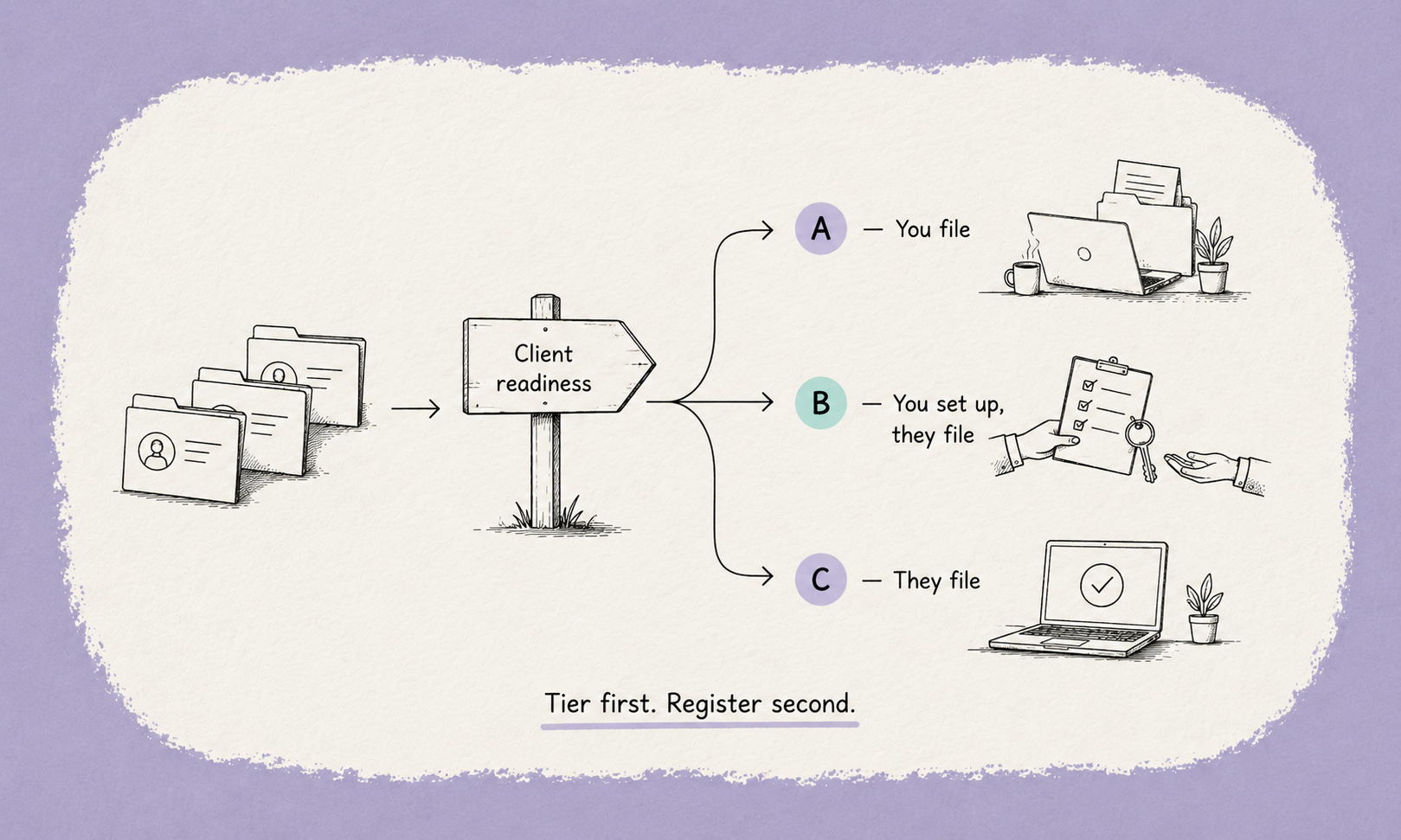
Three tiers, not one workflow
Firms already working through this on forums are converging on a pattern: not every, client gets the same level of service.
Tier A — you file. Full quarterly service, same as always. Reserved for your highest-value or highest-risk clients — the ones where getting it wrong costs the most.
Tier B — you set up, they file. You handle registration, software, and authorisation. The client submits their own quarterly updates. You step back in to finish the year. This is the middle tier: clients capable enough to run the process, but who need a push to get started.
Tier C — they file. Digitally confident, low-complexity clients run their own quarterly updates end to end. You handle the annual return.
Every tier still has to hit 7 August. The tiers change who does the filing — not whether it happens.
The managing partner's takeaway: decide the tier before you register the client, not after. Getting the tier wrong is a service-design problem you can fix. Getting the
registration wrong, per Armstrong Watson, might not be.
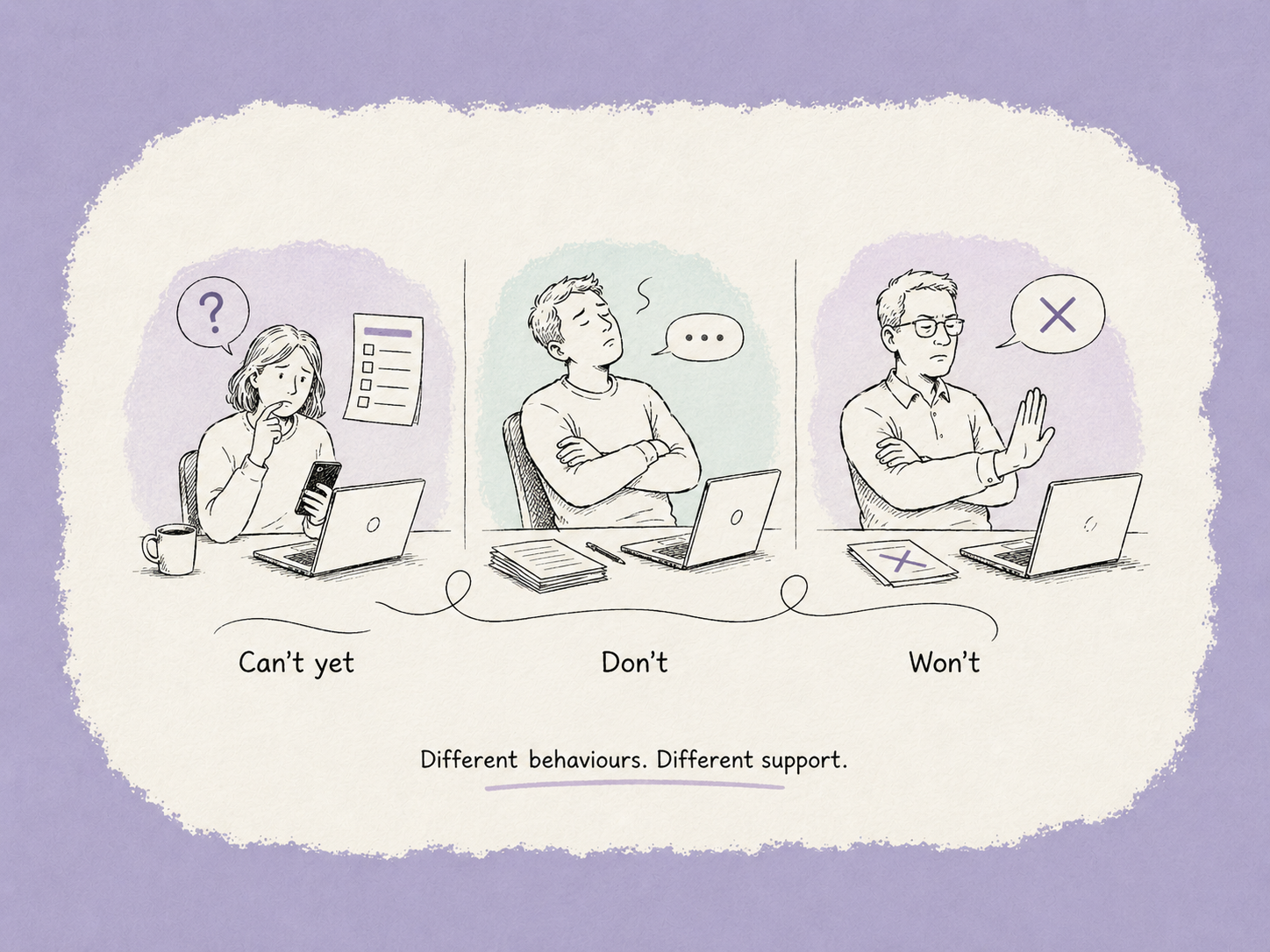
Solving the 'can't, don't, or won't' problem
What actually decides a client's tier isn't their income or their complexity — it's their relationship with software. ACCA's MTD webinar series, run with bookkeeping vendor AutoEntry, frames this as a "can't, don't, or won't" problem: some clients aren't able to use digital tools yet, some don't want to, and some simply refuse to, whatever the deadline says.
That distinction is worth splitting further, because each type drains staff time differently.
The client who won't. They resist software on principle. Every quarterly submission needs a phone call, a chased email, a scanned receipt three weeks late. Multiply that across two hundred clients and the friction compounds fast.
The client who can't yet. They want to comply but don't have the digital confidence to set up an app, link a bank feed, or navigate a Government Gateway account. Staff end up as unpaid IT support, walking someone through steps that should take five minutes and take fifty.
The client who's just disorganised. They have the software. They don't have the habits. Shoebox records, inconsistent categorising, missed check-ins — every quarter-end turns into a scramble instead of a routine job.
None of these is really a compliance problem. They're all a readiness problem, and each one points to a different tier: Tier A absorbs the "won't" clients, because someone has to file for them regardless. Tier B is built for the "can't yet" clients — worth some hand-holding now, because they'll get there. Tier C only works for clients who already have both the tools and the habits. Skip the segmentation and the cost doesn't disappear. It just lands on your staff, one unplanned phone call at a time.
The human cost: burnout before MTD even lands
The staffing problem isn't just operational. It's becoming a retention risk, and the industry's own numbers say so.
Silverfin's Efficient Firm 2026 Performance Report — sponsored research published via AccountingWEB this April, so read the numbers as the vendor's own findings rather than independent data — found that 25% of accountants are already showing signs of burnout, and firms are losing 1.2 hours a day per person to inefficiencies that could be automated. That's the baseline. MTD hasn't even added its four filing cycles a year on top yet.
One in four is not a fringe problem. It's a sign that the usual playbook — win more work, hire more people, push more volume through the same manual process — was already under strain before MTD arrived.
Manual task overload is the mechanism, not the headline. When a firm is running hundreds of MTD sign-ups across a fragmented client list — each one needing an identity check, a software authorisation, an HMRC record fixed — no single person holds that whole picture in their head. It ends up spread across spreadsheets, email threads, and sticky notes, and that kind of low-visibility, grinding admin is exactly what erodes morale fastest.
Talented staff leave when the work stops feeling manageable, and the people most likely to walk are usually the ones a firm can least afford to lose. MTD's rollout runs for years, not weeks — with out a structural fix, that's not a one-off spike in stress. It's a compounding problem: fewer staff left to absorb more client complexity.
What actually eats the time
Here's the part that doesn't show up in HMRC's guidance: the filing itself is rarely the bottleneck. It's everything around it — chasing a client for a bank statement, re-explaining what a quarterly update even is, resolving a mismatched National Insurance number with HMRC, tracking which of 300 clients have actually sent this quarter's records and which haven't.
None of that is technically difficult. It's just volume, and volume with out a system behind it turns into exactly what the AccountingWEB thread describes: a firm doing the maths and realising the people aren't there.
This is precisely the gap Workiro's Workflows is built to close — not by filing anything on a client's behalf, but by giving a firm one place to see who's been asked for what, what's outstanding, and what happens next, instead of that picture living across email threads, spreadsheets, and sticky notes. Ben Symons of Serenity Accounting & Bookkeeping, describing a related problem with client documents, put the outcome simply: "I don't have to chase anymore." That's the job MTD sign-up needs done at scale, this August and every quarter after it.If your firm is already triaging its MTD book differently — or you're staring down the same 300-plus number — we'd like to hear how you're handling it.
Sources: AccountingWEB, Any Answers, February 2026; ICAEW, June 2026; ICAEW, June 2026 — final mandation letters; Armstrong Watson, February 2026; ACCA / AutoEntry webinar, "MTD for income tax for clients who can't, don't or won't use software"; Silverfin Efficient Firm 2026 Performance Report, via AccountingWEB, April 2026 — sponsored/vendor research.
General information for accounting and professional-services firms, not advice – verify anything time-sensitive with the relevant tax authority or your professional body before acting on it.
Keep Every Client File Defensible — Without Slowing Down.
Book a demo




Industry-leading data security, for total peace of mind
We are a listed public company; currently protecting data for many of the world’s biggest professional brands.