
Payday Super Is Now Law: What Accountants Need to Get Right in Year One



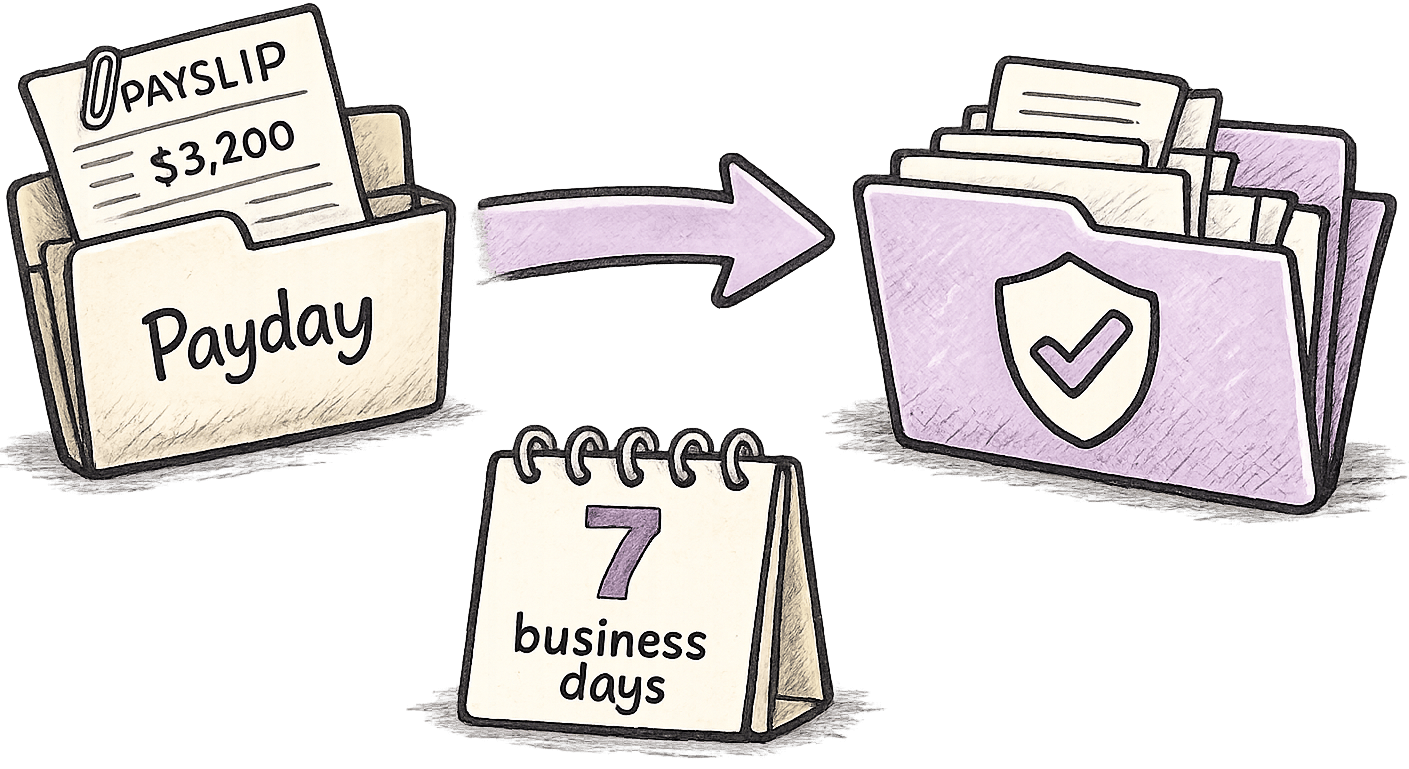
Payday super is no longer coming — it is here. Since 1 July 2026, employers must pay superannuation guarantee at the same time as salary and wages, with contributions reaching each employee's fund within 7 business days of payday. The quarterly cycle is gone, and for accountants the first payday super pay runs have already happened.
The framework sits in the Treasury Laws Amendment (Payday Superannuation) Act 2025, and the Payday Super Regulations filled in the delivery detail. Here is what the rules actually require, how the ATO is approaching year one, and where employer clients are most likely to get caught.
What is payday super?
Payday super requires employers to pay super guarantee (SG) contributions on payday rather than quarterly. SG is calculated as 12% of an employee's qualifying earnings (QE) — a new term that brings together ordinary time earnings and certain other payments — and contributions must be received by the fund, not merely sent, within 7 business days of payday. New employees, or employees who have changed funds, carry a longer first-payment window of 20 business days.
Two supporting changes make the timetable workable. Super funds now have 3 business days — down from 20 — to allocate or return contributions, and the New Payments Platform is available within SuperStream, enabling near-real-time super payments.
| The new rules at a glance | Detail |
|---|---|
| 💰 The rate and base | 12% of qualifying earnings (QE), the new term replacing ordinary time earnings |
| ⏱️ The deadline | Received by the fund within 7 business days of payday (20 for a new employee's first payment) |
| 👁️ Visibility | Qualifying earnings and super liabilities reported through Single Touch Payroll every pay cycle, under new code Q |
| ⚠️ Penalties | 25% of the unpaid charge, 50% for repeat cases, up to a 200% maximum, plus possible Fair Work exposure |
| 🚪 Clearing house | The small business clearing house (SBSCH) closed on 30 June 2026, so clients who relied on it need a new payment route now |
The part most firms underestimate: the ATO can now see everything
Employers must report QE and super liabilities through Single Touch Payroll every pay cycle, under a new reporting code, Q. That gives the ATO visibility of late or unpaid super in close to real time — payday by payday, not quarter by quarter.
The ATO has promised a facilitative first year, and that is true as far as it goes — but the data pipe that identifies every late payment is already switched on. A client who quietly smoothed super across the quarter no longer has a quarter to smooth across. The gap between "paid the wages" and "funded the super" is now visible to the regulator within days, and it is the accountant who will be asked to explain it.
What happens when a client pays late?
The super guarantee charge has been rebuilt. It now applies per payday, and it is assessed by the ATO directly — employers no longer lodge a super guarantee statement. The charge is calculated in four parts:
- The shortfall — the unpaid super itself, after any late contributions are offset
- Interest on the unpaid amount
- An administrative uplift — reflecting enforcement cost, reducible where the ATO has not taken prior action and the employer lodges a voluntary disclosure
- A choice loading where the employee's choice of fund was not followed
On top of the charge itself, penalties run at 25% of the unpaid charge, or 50% for repeat cases, with a maximum of 200% available in the worst cases. And the exposure is no longer only a tax problem: the Fair Work Ombudsman has put employers on notice that late super may also breach the Fair Work Act or an applicable award or enterprise agreement — opening the door to civil penalties and employee claims alongside the ATO's assessment.
How is the ATO enforcing year one?
For the implementation year to 30 June 2027, the ATO is running a risk-rated compliance framework — low, medium or high — taking a facilitative approach to minor errors made in good faith. It has been equally clear about the other side: a firmer stance on serious or deliberate non-compliance, including employers who simply don't attempt to pay SG each payday. Four draft Law Companion Rulings, published on 18 March 2026, carry the detailed interpretive guidance.
The practical reading for accountants: year one forgives clumsy, not casual. A client who has genuinely rebuilt their payroll process and stumbles on an edge case is in a defensible position. A client who is still running quarterly habits is not.
What should accounting firms do now?
Confirm every employer client has a working payment route. The Small Business Superannuation Clearing House closed on 30 June 2026 and is no longer accessible — clients who relied on it need payroll software or a commercial clearing house, and some will not have noticed until a payment fails.
Check STP is reporting code Q correctly. If the payroll software isn't reporting QE each cycle, the client is non-compliant even when the money moves on time.
Reset packaged-salary arrangements. Total remuneration packages that smoothed SG across the year no longer meet the rules — the cash and super split has to be right every payday.
Build the evidence trail per payday. Every pay run now generates its own compliance record: payment confirmations, fund receipts, rejected-contribution correspondence, and the client conversations around each of them. It is the payroll equivalent of working papers, built per pay run instead of per quarter. Firms managing dozens or hundreds of employer clients are discovering that the volume of super records has effectively multiplied by thirteen — from four quarterly events to a record per pay run — and that retrieving the right evidence quickly is what turns an ATO query from a project into an email. A document management system that files payment evidence and client correspondence against each client automatically is the difference between having paid super and being able to prove it — which is why firms running practice stacks like Xero Practice Manager increasingly connect document management directly to them.
Payday super rewards the firms that treat it as a systems change, not a dates change. The clients who feel it least will be the ones whose accountant rebuilt the process before the ATO's data did the asking. To see how firms are running per-payday evidence at scale, book a demo.
General information for accounting and professional-services firms, not advice – verify anything time-sensitive with the relevant tax authority or your professional body before acting on it.
Keep Every Client File Defensible — Without Slowing Down.
Book a demo




Industry-leading data security, for total peace of mind
We are a listed public company; currently protecting data for many of the world’s biggest professional brands.