



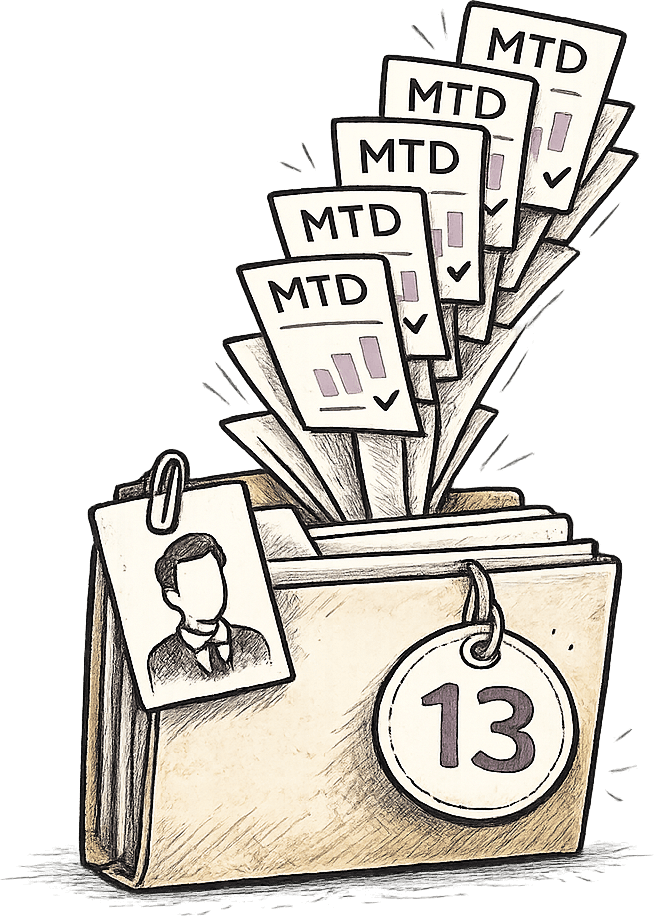
In short: Making Tax Digital for Income Tax creates a separate set of quarterly updates for every trade and every property business a client has, plus a year-end finalisation, on top of VAT cycles and the January payment date that never moved. Count it per client, not per calendar, and four filings a year turns out to be the floor, not the rule.
On an AccountingWEB MTD Accountability Club webinar, Chris Downing, director for accountants and bookkeepers at Sage, put the mechanic in one sentence: imagine the number of SA103s on a client's tax return today, because a quarterly update will be required for each one.
We've already run the firm-level maths on what MTD does to headcount: a client list becomes hundreds of filings in a five-week window. This piece goes one level down, to the single client file, where the number gets stranger. One client isn't four filings. Build their stack properly and it can be thirteen.
How many MTD filings does one client actually have?
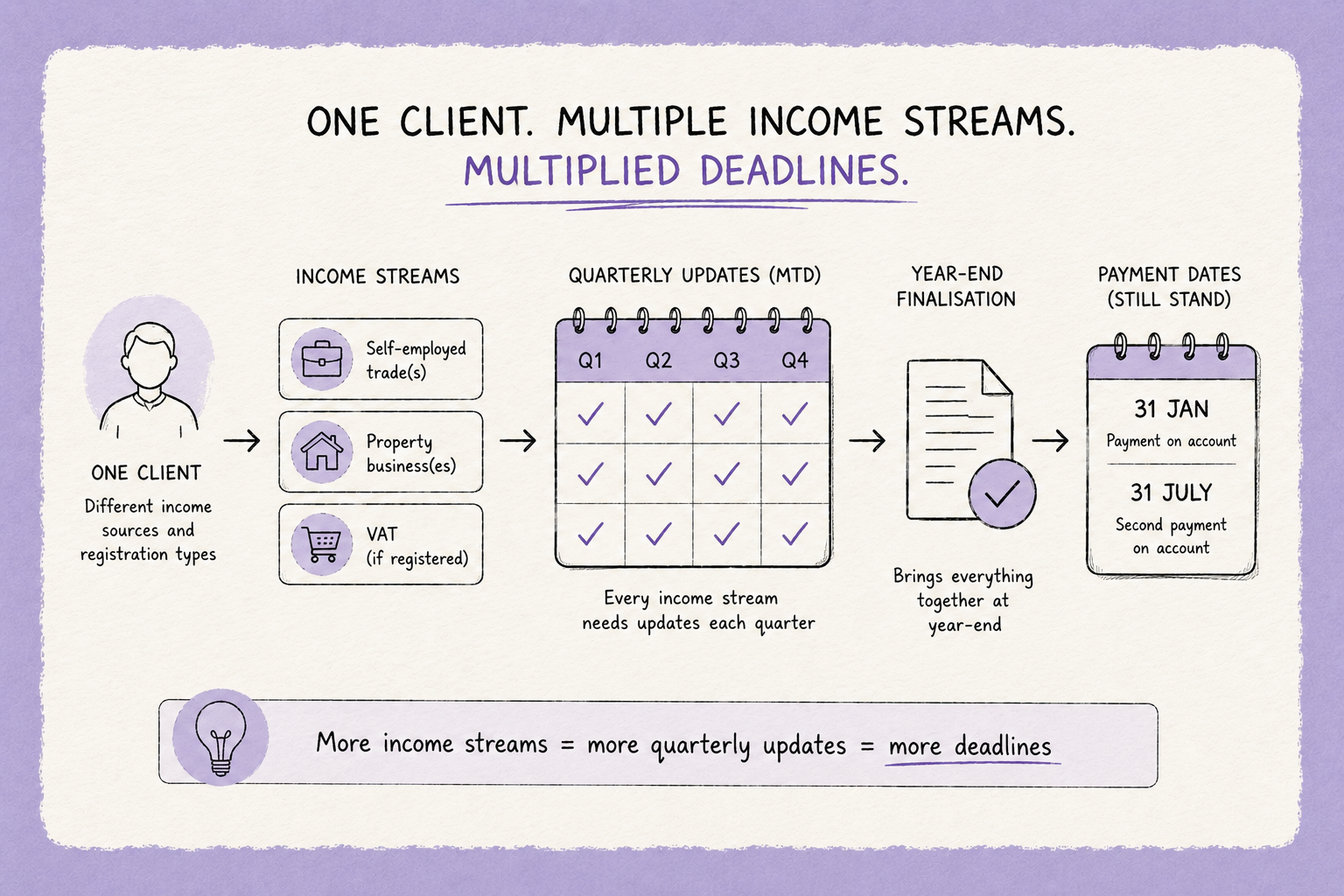
More than four, for anyone with more than one income source. Each self-employed trade needs its own quarterly updates. Property income forms its own business with its own updates, and joint ownership means reporting the client's proportional share across their whole portfolio, as Downing set out in the same webinar alongside the ATT's Emma Rawson. The year-end finalisation then brings it all together.
Count it for a client you actually have:
| The client | MTD quarterly updates | Year-end | VAT returns | Total submissions |
|---|---|---|---|---|
| One trade | 4 | 1 | 0 | 5 |
| Two trades | 8 | 1 | 0 | 9 |
| Two trades + rental property | 12 | 1 | 0 | 13 |
| Same client, VAT-registered | 12 | 1 | 4 | 17 |
The 31 January and 31 July payment dates are unchanged, and additional to every row above.
And the 31 January and 31 July payment dates still stand. The quarterly updates changed how income is reported; they didn't move when tax is paid.
The software side compounds it. In one AccountingWEB thread, a firm with a VAT-registered client running two trades files a single VAT return through one licence, but was quoted a second licence just to submit the second trade's quarterly updates. Another member's workaround ran across four separate products for one client. The filing is a click; the choreography around it is the job.
Why do the deadlines hurt more than the digital records?
Because the digital part mostly works. New research from Landlord Studio found 22% of UK landlords have considered leaving the rental market over MTD, and it would be easy to read that as "digital tax is too hard". The same survey says otherwise: 74% of those landlords agree MTD is actually making their tax easier to manage, and over half expect it to improve their profitability.
So what's driving a fifth of them towards the exit? Time. They now spend an average of 13 hours a month on tax and financial admin, which they value at more than £3,000 a year. Their biggest stated fears are keeping accurate records (38%) and errors leading to penalties (36%), which means the anxiety isn't about typing numbers into software. It's about whether the right records are in the right place when each window closes.
That's the deadline stack in one finding: the burden was never digitisation. It's the multiplication of dates, and the collecting, checking and evidencing that each one demands.
And it lands on a client base already halfway out the door. Around 93,000 buy-to-let landlords exited the market in 2025, on LandlordBuyer's figures, and the official English Private Landlord Survey has 31% of those remaining planning to shrink their portfolios; even landlord-facing commentators conclude the exit driver is the cumulative load of keeping up rather than any single rule. Which means, for a practice, the stack isn't just admin. Every landlord who quits is recurring fees off the book, and the firm that visibly carries the stack is the one that keeps the client.
The stack is still growing, too. MTD for Income Tax has applied since April 2026 to those with qualifying income over £50,000, dropping to £30,000 from April 2027 and £20,000 from April 2028, measured on combined self-employment and property income. Each spring adds a new wave of clients, each arriving with their own stack.
What does the deadline stack look like inside a firm?
It looks like a Thursday at 4:50pm, three weeks into a filing window: the third chase email to a landlord client for June's letting statements, a sole trader's second-trade records half-collected in a shared inbox, and a draft sent for approval that's gone quiet. The old rhythm was one January scramble a year. The new one is that same collection-and-approval loop, per income stream, four times a year, and no two clients' loops are the same size.
The point: a firm can't staff its way out of a diary problem. It has to be able to see it.
How do firms keep a multiplied diary defensible?
Three moves, and none of them requires new software to start.
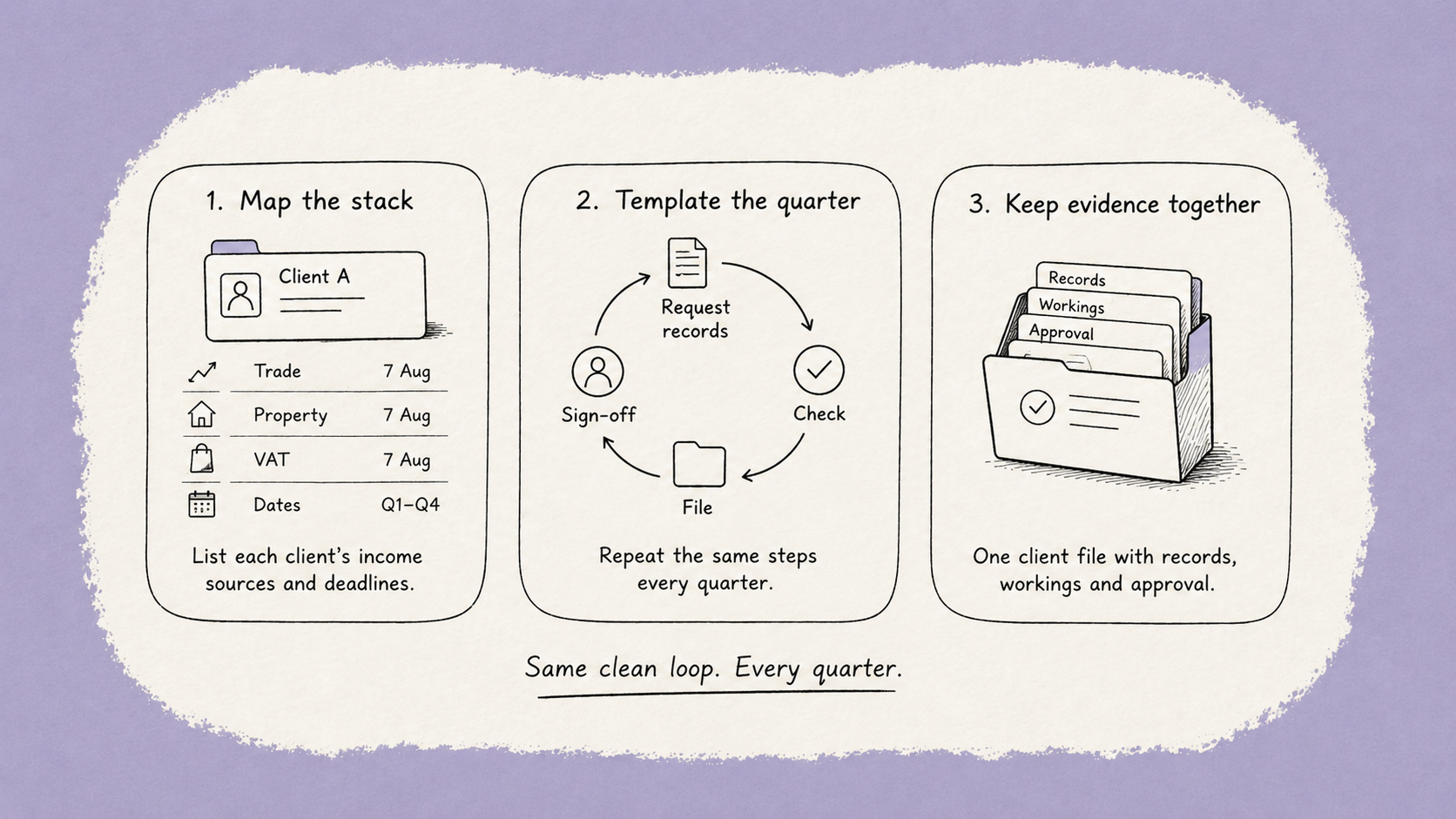
Map the stack per client, once. For every MTD client, write down each income source, each quarterly obligation it creates, the VAT cycle if there is one, and the payment dates. Most firms discover the same thing: a handful of clients account for most of the stack. Those are the ones whose records need a standing rhythm, not a deadline-week scramble.
Make the quarter a template, not a memory. The work that repeats four times a year (request the records, check them, file the update, capture the client's sign-off) should exist as a repeatable workflow with named owners and automatic reminders, so a chase happens because the system prompted it, not because someone remembered at 4:50pm. Firms already ask for exactly this in forums, almost word for word: "our system will chase automatically for the records." The tools most firms already run, from TaxCalc and IRIS to Xero, can feed that rhythm rather than fight it when they're connected in one place.
Keep the evidence where the deadline can find it. Every update rests on records, workings and an approval. If those live across inboxes, drives and a portal clients forget the password to, each quarter re-runs the same hunt. Lloydbottoms, a four-person chartered firm in Bristol, moved fifteen years of documents into one system and dropped client logins entirely; as director Susan Rickerby puts it, "It all stays in one place. People know they need to look at it because it's got their name on it." When a request carries the client's name and needs no password, clients act inside the window instead of after it. Rachael at NES Accountancy saw the same at tax-return peak: "once the client signed it, it's all filed", and the client resistance she feared "never materialised".
Do this before the next window opens:
☐ List each MTD client's income sources
☐ Count the quarterly updates each source creates
☐ Add their VAT cycle and payment dates
☐ Flag the top ten stack-heaviest clients
☐ Set a standing records-request date per quarter, per client
☐ Pick one home for the records, workings and sign-off trail
Quarterly deadlines don't reward heroics. They reward the same clean loop, run on time, with a trail that would hold up if anyone ever asked.
See your own deadline stack on one page
We've built a free MTD deadline calendar for 2026-27 that lays the quarterly windows against VAT cycles and the Self Assessment dates, so you can see exactly where they collide for your client base, then add every deadline to your own calendar in one click with two-week reminders built in. No sign-up, no gate: MTD deadline calendar 2026-27.
Where Workiro fits
Everything above works whatever your stack. Where firms use Workiro for it: the quarterly loop becomes a recurring workflow with automatic chasing, client records and approvals file themselves against the right client, and the evidence trail behind every update builds as the work happens. If you want to see what a full quarterly cycle looks like end to end, book a demo and bring a real multi-stream client; we'll map their deadline stack with you. Not demo-ready? Start with how firms run tax return collection without the chase.
Frequently asked questions
Does each self-employed trade need its own MTD quarterly updates?
Yes. Every trade that would have its own SA103 today needs its own quarterly updates, which is why clients with multiple income streams have far more than four filings a year. See how firms run tax return preparation around that cycle.
Do quarterly updates replace the tax return?
No. A year-end finalisation still brings everything together, and the January and July payment dates are unchanged. Firms keeping working papers organised quarterly find year-end far lighter.
How is joint property handled under MTD?
Each owner reports their proportional share across their whole property portfolio, which makes joint landlords some of the most calendar-heavy clients on a firm's list. See how accounting practices structure it.
When do more clients come into MTD?
The qualifying-income threshold is £50,000 now, dropping to £30,000 from April 2027 and £20,000 from April 2028. Our free MTD deadline calendar shows each year's windows.
General information for accounting and professional-services firms, not advice – verify anything time-sensitive with the relevant tax authority or your professional body before acting on it.
Keep Every Client File Defensible — Without Slowing Down.
Book a demo




Industry-leading data security, for total peace of mind
We are a listed public company; currently protecting data for many of the world’s biggest professional brands.