
Iris Document management for Iris accountants: modernise the workflow, keep the tax software



Running an Iris practice means your tax software isn't the issue. Iris excels in tax computations and account filings - compliance remains its strong suit. However, optimising Iris Document Management for Iris accountants is where the real challenge lies.
You're constantly chasing records before deadlines, awaiting client approvals on returns, and scrambling for files during HMRC inquiries. These tasks aren't streamlined within Iris; instead, they reside in tools like OpenDocs or Invu, scattered across desktops, mailboxes, and drives.
When partners seek document management for Iris accountants, they want a solution that enhances Iris without slowing down their processes. Let's explore how this can be achieved effectively.
Iris excels in tax; the Iris Document Management layer creates bottlenecks
Iris is a robust tool for tax and accounts production, and there's no need to replace it. However, the document management aspect tells a different story. OpenDocs and Invu are limiting, turning simple approvals into tedious tasks. Files end up scattered, making it difficult to identify the final version.
This disconnect is costly. Research by the McKinsey Global Institute found that knowledge workers spend close to a fifth of the working week — around 1.8 hours a day — just searching for and gathering information. When your document layer is scattered across desktops, drives and inboxes, that's where the time goes.
Increased filing frequency adds complexity
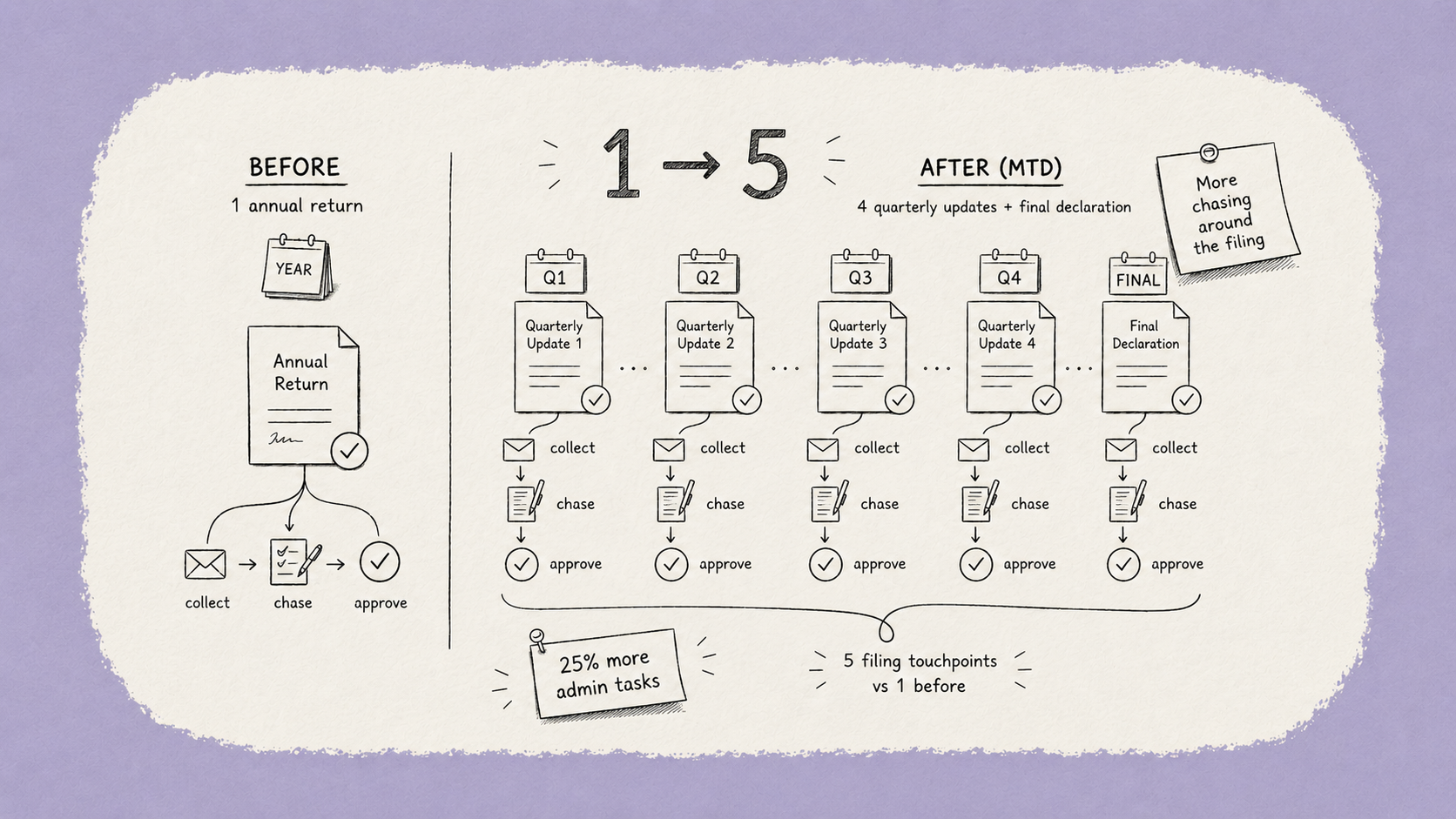
Making Tax Digital for Income Tax has intensified the workload. Sole traders and landlords now file four quarterly updates plus a final declaration, increasing from one annual return. Over 864,000 individuals earning above £50,000 are impacted initially.
Consider your own clients. Each one you would chase annually now requires four follow-ups. While IRIS handles the filing, the surrounding work - document collection, follow-up, and sign-off - multiplies, areas where desktop tools struggle. According to ICAEW, HMRC expects 2.9 million taxpayers to fall under MTD for Income Tax across its phases, with 864,000 mandated from April 2026. Each now files four quarterly updates plus a final declaration instead of one annual return — so the document collection and follow-up around each client multiplies.
What effective Iris Document Management looks like for an Iris firm
Forget about labels for a moment. The real question is whether specific tasks become easier. Here's how efficient document management transforms your practice:
Chasing records before a deadline. Managing 200 clients with three chases each results in 600 manual emails, with no visibility into responses. Replace this with a secure link, a checklist, and automated reminders. You can instantly see progress, allowing records to arrive early rather than at the deadline. Learn more about year-end collection.
Review, sign-off, and client approval. Even after preparing a return in IRIS, it requires a manager's approval and a client's signature. If left in an inbox, it's unclear if it's approved, rejected, or pending - while deadlines loom. Transform this into a tracked task with real-time outcomes, using timestamped e-signatures. Approvals can be completed within minutes from any device. Explore tax-return approvals.
AML and onboarding before work starts. For new clients, ID verification, proof of address, risk rating, and engagement letters are mandatory. When done via email, drives, and spreadsheets, it involves 15-20 steps, risking non-compliance with MLR 2017. A streamlined process - request, collect, verify, rate, e-sign - creates a complete trail, easily retrievable during audits. Discover client onboarding.
Finding the file during HMRC inquiries. When HMRC questions a return filed two years ago, you need immediate access to working papers and approvals. Store every version with the client, complete with searchable history, and respond to HMRC promptly with a timestamped trail.
The underlying principle is clear: documents indicate what you have; a workflow directs what you do with them, eliminating unnecessary chasing.

The integration question every Iris partner asks first
Before implementing changes, ensure integration with existing tools. It's a valid concern.
Workiro integrates seamlessly with Iris practice data, functioning alongside your current setup. It also syncs with TaxCalc, Sage, Xero, and Microsoft 365. Outlook automatically files HMRC emails, client queries, and tax discussions with the right client record, building an audit trail effortlessly.
That integration is often the deciding factor. You retain Iris for compliance and enhance everything around it. See the IRIS integration.
Success stories from firms that upgraded their document layer
Numbers speak louder than adjectives.
Serenity, led by Ben Symons, reduced practice-management admin by half and saved over £40,000 annually - more than 400 hours - by consolidating everything in one place. Ben states, "Now I can see everything - what's been sent, what's been signed, and what's still waiting. I don't have to chase anymore." Read the Serenity story.
Rachel Fowler went entirely paperless, saving 20 days annually in administrative tasks. She values the ability to "find everything myself." Read Rachel's story.
This scalable approach is adopted by Larking Gowen, a Top 40 firm with 450 staff, embracing a unified source of truth across the practice.
Ultimately, your reputation is only as strong as your client file. When a regulator, court, or client requests it, "everything in one place" becomes your safeguard.
"But migration would be a nightmare"
Fear of migration often keeps firms stagnant. Here's a straightforward answer.
Migration typically takes under 21 days, with minimal involvement from your team. There's no downtime; the transition occurs in the background. Nothing leaves your existing system until you've verified a sample, and your old system stays live throughout.
Staying with outdated systems isn't cost-free either. Desktop tools that lack mobility, support delays, and an ever-increasing chase due to MTD all impose costs - though not as a line item on an invoice.
The missing link for Iris practices: A guide to modern document management
Iris handles the complexities of tax and account filings with precision. However, many firms still find themselves bogged down by the manual tasks that sit on top of that compliance engine. From chasing client records for MTD updates to managing the approval flow for a CT600, the document side of the equation often feels like it's trailing behind the software's capabilities.
If you're struggling to see where the compliance work ends and the administrative friction begins, you aren't alone. It's the primary reason Workiro developed a dedicated resource for partners looking to modernise without the disruption of a full software migration.
We've compiled a concise guide that breaks down the exact steps required to bridge the gap between your tax software and a truly paperless, mobile-ready workflow. Learn how to centralise your audit trails and eliminate the 'Friday afternoon chase' for good.
Where to start
You don't need to commit to anything to experience the difference. Bring one real return - be it a CT600, a year-end, or an onboarding - and we'll demonstrate where it currently stalls and how to eliminate those delays.
Iris will continue managing taxes. Everything else will cease to be a chase.
Backed by GetBusy plc, whose software is trusted by 65,000+ professionals.
Key Iris Document Management Takeaways
The benefits of using Workiro alongside Iris include the ability to easily:
- Chase records before a deadline.
- Review, sign-off, and client approval.
- Set up AML and onboarding before work starts.
- Find the correct file when HMRC enquires.
Last updated: June 30, 2026
General information for accounting and professional-services firms, not advice – verify anything time-sensitive with the relevant tax authority or your professional body before acting on it.
Keep Every Client File Defensible — Without Slowing Down.
Book a demo




Industry-leading data security, for total peace of mind
We are a listed public company; currently protecting data for many of the world’s biggest professional brands.